Blog
Why Electric Actuators Are Essential for Valve Automation
2026-06-01
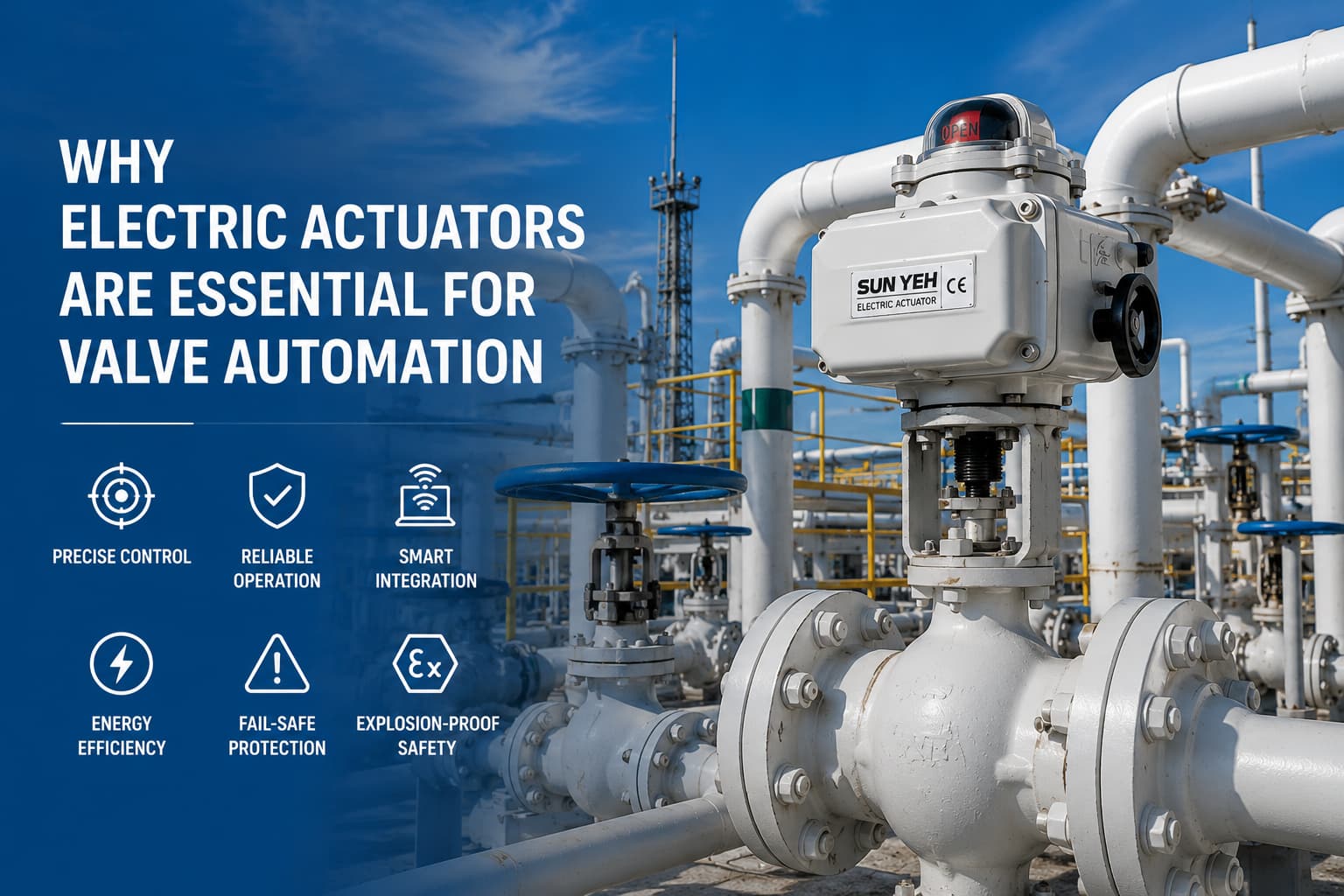
In our previous article, “What Is a Motorized Valve and How Does It Work?”, we explained how motorized valves combine a valve and an electric actuator to achieve automated flow control. While the valve regulates the flow of liquids, gases, steam, or air, the true driving force behind automation is the electric actuator itself.
As industrial facilities continue adopting smart manufacturing, remote monitoring, and Industry 4.0 technologies, electric actuators have become a critical component in modern valve automation systems. They provide precise motion control, reliable operation, fail-safe functionality, and seamless integration with digital control platforms.
Founded in Taiwan in 1986, Sun Yeh Electrical Ind. Co., Ltd. specializes in the development and manufacturing of electric actuators for industrial valve automation. Sun Yeh’s actuator portfolio includes quarter-turn electric actuators, spring-return fail-safe actuators, SuperCap fail-safe actuators, linear electric actuators, multi-turn actuators, and explosion-proof electric actuators. These products are widely used in oil & gas, water treatment, HVAC, tunnel ventilation, chemical processing, mining, environmental protection, and many other industries.
What Is an Electric Actuator?
An electric actuator is a device that converts electrical energy into mechanical motion to operate a valve, damper, or other flow-control equipment.
When a control signal is received, the actuator's motor generates torque or thrust through an internal gear mechanism. This movement is then transferred to the valve stem, allowing the valve to open, close, or regulate flow automatically.
Unlike manual valve operation, electric actuators allow precise and repeatable control while reducing labor requirements and improving operational efficiency.
Why Valve Automation Depends on Electric Actuators
Although valves control the media flowing through a system, they cannot automate themselves.
Without an actuator:
- Operators must manually adjust valve positions
- Remote control is impossible
- Process consistency becomes difficult
- Emergency automation functions cannot be implemented
Electric actuators provide the intelligence and motion required to transform traditional valves into automated control devices. This is why electric actuators are often considered the foundation of modern valve automation systems.
1. Precise Flow Control and Positioning Accuracy
One of the biggest advantages of electric actuators is their ability to provide highly accurate valve positioning.
Modern actuators support:
- On/Off control
- Floating control
- Modulating control
- 4–20mA positioning signals
- 0–10V control signals
This level of control allows facilities to regulate:
- Water flow rates
- Steam pressure
- Cooling water circulation
- Chemical dosing systems
- Air flow management
Precise positioning improves process stability while reducing waste and energy consumption.
2. Easy Integration with Industry 4.0 Systems
As factories become increasingly digitalized, electric actuators play a vital role in smart automation networks.
Modern actuator systems can integrate with:
- PLC systems
- SCADA platforms
- Building Management Systems (BMS)
- Distributed Control Systems (DCS)
- Remote monitoring platforms
Electric actuators support centralized valve management and real-time operational visibility, making them ideal for Industry 4.0 environments.
3. Reliable Operation in Critical Industrial Applications
Industrial valve systems often operate continuously under demanding conditions.
Sun Yeh electric actuators are designed to provide:
- Stable output torque
- Reliable motion control
- Low-noise operation
- Durable gear mechanisms
- Long service life
Their robust structure makes them suitable for demanding applications such as:
- Water treatment plants
- HVAC systems
- Tunnel ventilation
- Power generation facilities
- Petrochemical processing plants
Sun Yeh electric actuators are compatible with butterfly valves, ball valves, plug valves, dampers, and globe valves across numerous industries.
4. Fail-Safe Protection During Power Failure
Some applications require valves to move automatically to a safe position during power loss.
This is especially important in:
- Fire protection systems
- Smoke extraction systems
- Tunnel ventilation systems
- Emergency shutdown systems
- Chemical processing facilities
Sun Yeh offers specialized actuator solutions including:
Spring Return Fail-Safe Electric Actuators
These actuators utilize stored spring energy to automatically drive valves to a predefined fail-safe position during power loss.
SuperCap Fail-Safe Electric Actuators
These systems use supercapacitor energy storage to provide controlled emergency valve movement without mechanical springs.
Fail-safe functionality significantly improves system safety and operational protection.
5. Explosion-Proof Protection for Hazardous Environments
Many industrial facilities contain:
- Flammable gases
- Combustible dust
- Chemical vapors
In these environments, standard actuators may not provide sufficient protection.
Sun Yeh's explosion-proof electric actuators are designed for hazardous locations and comply with international protection standards including:
II 2 GD Ex db IIB T4 Gb / Ex tb IIIC T130°C Db
These actuators are suitable for:
- Petrochemical plants
- Natural gas facilities
- Chemical processing plants
- Dust-hazard environments
- Oil & gas infrastructure
Their flameproof and dust-proof construction helps ensure safe operation in high-risk industrial environments.
Major Types of Electric Actuators Used in Valve Automation
Quarter-Turn Electric Actuators
Quarter-turn actuators rotate valves 90 degrees and are commonly used with:
- Ball valves
- Butterfly valves
- Plug valves
Sun Yeh’s OM Series quarter-turn electric actuators provide torque ranges from 35 Nm to 4500 Nm and feature self-locking planetary gearing and clutch-less manual override design.
Linear Electric Actuators
Linear actuators generate straight-line thrust motion and are commonly used with:
- Globe valves
- Control valves
- Gate valves
These actuators provide precise flow regulation in HVAC, steam control, and industrial process systems.
Fail-Safe Electric Actuators
Fail-safe actuators automatically move valves to predefined safety positions during power interruption. They are essential in emergency response systems and critical infrastructure applications.
Why More Industries Are Choosing Electric Actuators
| Benefit | Advantage |
|---|---|
| Automation | Eliminates manual valve operation |
| Accuracy | Precise positioning and modulation |
| Safety | Supports emergency and fail-safe control |
| Remote Operation | Enables centralized monitoring |
| Energy Efficiency | Optimizes system performance |
| Industry 4.0 Compatibility | Supports smart automation systems |
| Reliability | Long-term stable operation |
FAQ – Electric Actuators for Valve Automation
Q1. Why is an electric actuator necessary for valve automation?
Electric actuators provide the motion and control required to automatically operate valves without manual intervention.
Q2. What types of valves can use electric actuators?
Electric actuators are commonly used with butterfly valves, ball valves, plug valves, globe valves, gate valves, and dampers.
Q3. What is the difference between a motorized valve and an electric actuator?
A motorized valve is a complete assembly that includes both a valve and an electric actuator. The actuator provides the mechanical movement.
Q4. When is a fail-safe electric actuator required?
Fail-safe actuators are used when valves must automatically move to a safe position during power failure or emergency shutdown conditions.
Q5. Are electric actuators suitable for hazardous environments?
Yes. Explosion-proof electric actuators are specifically designed for hazardous locations where flammable gases or combustible dust may be present.
Conclusion: Electric Actuators Are the Core of Modern Valve Automation
As industries continue moving toward smarter, safer, and more efficient operations, electric actuators have become indispensable for valve automation. They provide the precision, reliability, safety, and digital integration capabilities required by modern industrial systems.
From quarter-turn valve automation and linear motion control to fail-safe emergency protection and hazardous-area applications, electric actuators play a central role in keeping industrial processes running safely and efficiently.
With decades of engineering expertise and a comprehensive actuator product lineup, Sun Yeh Electrical Ind. Co., Ltd. continues to support global industries with reliable valve automation solutions designed for long-term performance and operational excellence.
