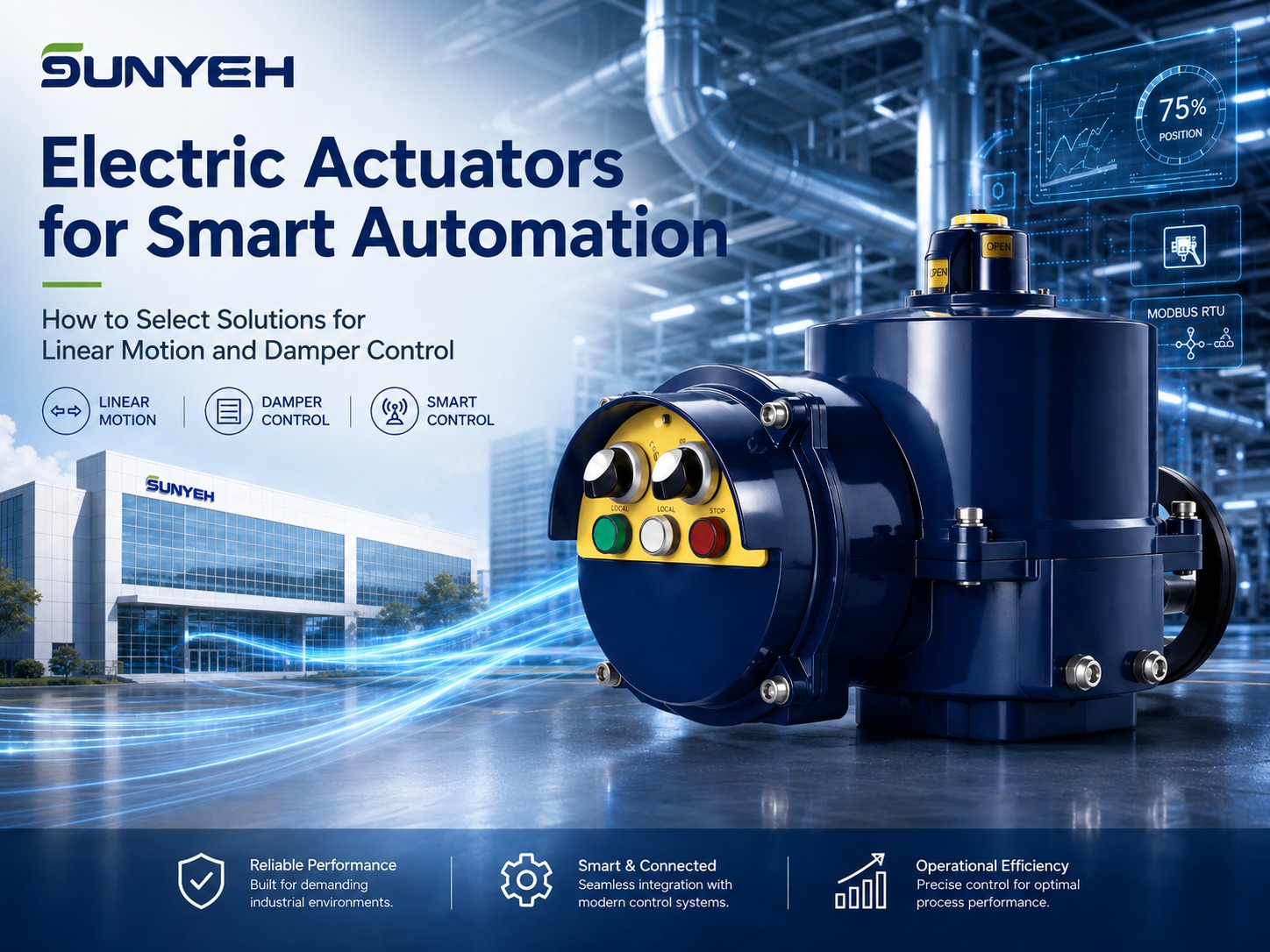
Electric Actuators for Smart Automation: How to Select Solutions for Linear Motion and Damper Control
Smart automation is changing how industrial facilities control valves, airflow, ventilation, and process conditions. However, selecting an electric actuator for a modern automation system is not simply a matter of choosing the model with the most advanced functions. The actuator must first match the mechanical movement and controlled equipment, and then provide the appropriate level of control, feedback, and communication.
This distinction is especially important when discussing linear electric actuators, electric damper actuators, and smart electric actuators. These terms describe different aspects of actuator selection. “Linear” refers to the motion produced by the actuator, “damper” describes an application, while “smart” generally refers to enhanced control, feedback, or communication capabilities.
Understanding these differences helps engineers, OEMs, valve manufacturers, and system integrators select an actuator based on actual operating requirements rather than terminology alone.
1. Understanding Linear Motion and Damper Control Requirements
A linear electric actuator generates straight-line movement and thrust, making it suitable for globe valves and other devices that require axial stem travel.
Damper control, on the other hand, refers to the application. Many industrial ventilation dampers use quarter-turn or limited-angle rotary movement, although the actual actuator arrangement depends on the damper mechanism.
For this reason, a linear electric actuator and an electric damper actuator should not automatically be treated as two competing actuator categories.
Within SUN YEH’s product range, the L Series Electric Linear Valve Actuators are designed for globe valves and other linear-motion devices. For quarter-turn valve and damper applications, the OM Series provides rotary actuation, while the S Series adds mechanical spring-return capability where fail-safe positioning is required.
2. When Is a Linear Electric Actuator the Right Choice?
Globe valves are a common example. Their stems move linearly to change the position of the internal closure element and regulate flow. In these applications, actuator sizing is therefore based primarily on thrust and stroke.
SUN YEH’s L Series provides thrust from 250 to 2,000 kgf (approximately 2.45 to 19.6 kN). Modulating control is a standard feature, allowing the actuator to respond to an input signal while providing position feedback.
Depending on the model, maximum stroke is 50 mm or 100 mm. The series also includes adjustable stroke, a continuous mechanical position indicator, and manual override.
These characteristics make the L Series suitable for globe valves and other linear-motion applications used in HVAC systems, industrial facilities, boilers, and heating systems.
Key considerations include required thrust, stroke, operating speed, control signal, feedback requirements, power supply, and installation environment.
3. When Is an Electric Damper Actuator the Right Choice?
“Damper actuator” does not define one specific actuator motion. The mechanical design of the damper still determines whether rotary, limited-angle, or another actuation arrangement is required.
In tunnel and metro applications , SUN YEH identifies its OM Series quarter-turn electric actuators and S Series spring-return quarter-turn electric actuators for ventilation systems, smoke extraction systems, and emergency control.
During normal operation, a damper may regulate airflow. In a safety-related application, however, the system may also require the damper to move to a predefined position during power loss.
SUN YEH’s S Series uses a spring-driven pinion-and-rack mechanism. During powered operation, the spring stores mechanical energy. When electrical power is removed, the stored energy drives the connected valve or damper to a defined fail-safe position according to the system design.
4. What Makes an Electric Actuator “Smart”?
The mechanical requirement still comes first. A linear valve requires suitable thrust and stroke, while a rotary valve or damper requires the appropriate torque and rotation.
Smart capability is considered after the mechanical actuator platform has been established. Depending on the application, this can involve proportional positioning, feedback, digital communication, or local and remote operating functions.
For SUN YEH products, these capabilities depend on actuator series, model, voltage, and configuration. They should therefore be specified according to the actual automation architecture rather than assumed to be standard across every actuator.
5. Key Smart Control Functions: Modbus, Position Feedback, and Local/Remote Control
Modulating Control
Modulating control allows an actuator to move to intermediate positions instead of operating only fully open or fully closed.
This is useful in applications where flow, temperature, or other process conditions require proportional adjustment.
SUN YEH’s L Series uses modulating control as a standard feature. Specified input signals include 4–20 mA, 1–5 V, or 2–10 V, while output feedback options include 4–20 mA or 2–10 V.
Position Feedback
Position feedback allows the control system or operator to verify the actuator’s actual position.
Depending on the actuator and selected configuration, position information may be provided through mechanical indicators, potentiometers, or analog feedback signals.
Modbus Communication
Selected SUN YEH actuator configurations support Modbus communication, an established industrial communication protocol used for data exchange between compatible automation devices.
For the OM Series, Modbus RTU RS485 is available on specified model, voltage, and duty-cycle combinations. SUN YEH also lists Modbus as a communication option for the L Series.
An important technical point applies to the L Series: Modbus and modulating control cannot operate at the same time. The intended control architecture should therefore be determined before the actuator configuration is finalized.
Local/Remote Control
Selected OM Series actuators can be equipped with a Local Control Unit that provides LOCAL/REMOTE and CLOSE/OFF/OPEN selector functions.
This allows field personnel to operate the actuator locally during commissioning, inspection, testing, or maintenance while supporting centralized operation during normal service.
6. How to Combine Mechanical and Smart-Control Requirements
This approach differs from a general actuator selection guide because the focus is not on reviewing every actuator category. Instead, it shows how mechanical requirements and automation requirements should work together.
Layer 1: Mechanical Compatibility
The actuator must first satisfy the physical requirements of the controlled equipment.
For a linear application, this means confirming required thrust, stroke, and operating speed. For a rotary valve or damper, the main considerations include torque, rotation angle, and mechanical connection.
If these requirements are incorrect, advanced communication or feedback functions cannot compensate for an improperly matched actuator.
Layer 2: Smart-Control Integration
Once mechanical compatibility has been confirmed, automation requirements can be added. These may include On/Off or modulating control, position feedback, Modbus communication, Local/Remote operation, and the required fail-safe response.
| Requirement Layer | Primary Question | Examples |
|---|---|---|
| Mechanical | Can the actuator physically operate the device? | Thrust, torque, stroke, rotation |
| Process Control | How should the equipment respond during normal operation? | On/Off, floating, modulating |
| System Integration | What information must be exchanged? | Position feedback, Modbus |
| Safety | What happens during power loss or an emergency? | Fail Open, Fail Closed, or defined system response |
| Field Operation | Does local operation need to remain available? | Manual override, Local/Remote control |
| Environment | What conditions will the actuator operate in? | Temperature, humidity, dust, enclosure protection and IP rating |
For example, a globe valve may first require a specific thrust and stroke. If the process also requires proportional regulation, modulating control and position feedback then become relevant.
A tunnel ventilation damper may first require suitable torque and quarter-turn movement. If it is also part of an emergency-control strategy, a defined fail-safe response becomes an additional system requirement.
7. Application Examples: Globe Valve Control, HVAC Systems, and Tunnel Ventilation
Globe Valve Control
Globe valves commonly require straight-line stem movement and controlled positioning.
For these applications, a linear electric actuator converts electrical input into the thrust and stroke required to move the valve stem. When modulating control is used, the actuator can position the valve between fully open and fully closed states.
SUN YEH’s L Series is designed for globe valves and other linear-motion devices where controlled linear positioning is required.
HVAC Systems
HVAC and thermal-management systems can contain different valve structures and therefore may require multiple actuator solutions.
SUN YEH identifies its OM, T, and CM quarter-turn actuator series, together with the L Series linear actuators, for chiller, cooling tower, and HVAC applications .
An HVAC project may use quarter-turn actuators for rotary valves while using linear actuators for globe valves or other linear-motion devices. The application itself does not determine the actuator type; the controlled equipment and operating requirements do.
Tunnel and Metro Ventilation
Tunnel and metro ventilation systems may combine normal airflow management with emergency smoke-control requirements.
SUN YEH identifies OM Series quarter-turn actuators and S Series spring-return actuators for ventilation, smoke extraction, and emergency control in tunnels and stations.
During normal operation, actuators may support ventilation and airflow control. During an emergency or power-loss condition, selected dampers may instead need to move to a predefined safe position according to the system design.
8. FAQ: Linear, Damper, and Smart Electric Actuators
A linear electric actuator is defined by its straight-line output motion. An electric damper actuator is defined by its application— operating a damper. They are not directly opposing actuator categories. The correct actuator depends on the mechanical design and movement of the controlled equipment.
For rotary actuators, selection is generally based on torque. For linear electric actuators, selection is based on thrust. The required output should be determined from the valve, damper, or equipment operating requirements.
Useful functions may include modulating control, position feedback, Modbus communication, and Local/Remote operation. The correct combination depends on how the actuator must interact with the automation system.
Yes. SUN YEH lists Modbus as a communication option for the L Series. However, Modbus and modulating control cannot operate simultaneously, so the intended control architecture should be confirmed before the actuator configuration is finalized.
No. Fail-safe operation is necessary when the system requires the damper to move to a defined safe position during power loss or an emergency condition. For applications requiring mechanical spring-return operation, SUN YEH’s S Series provides Fail Open or Fail Closed operation according to system requirements.
Conclusion
A linear electric actuator must provide suitable thrust and stroke. An electric damper actuator must match the damper’s movement, torque, and operating requirements. Smart-control functions such as modulating control, position feedback, Modbus communication, and Local/Remote operation should then be added according to the automation architecture.
Sun Yeh Electrical Ind. Co., Ltd. provides electric actuator solutions covering linear motion, quarter-turn control, spring-return fail-safe operation, modulating control, position feedback, and selected communication functions for applications including globe valve control, HVAC systems, tunnel and metro ventilation, and industrial valve automation.
Discuss Your Electric Actuator Requirements with SUN YEH
For OEMs, engineering companies, valve manufacturers, system integrators, and industrial project teams, actuator evaluation becomes more efficient when the operating requirements are defined before product selection.
When contacting SUN YEH, providing the following project information can help narrow down a suitable actuator configuration:
- Valve or damper type
- Required torque or thrust
- Stroke or rotation angle
- Operating voltage
- Control signal
- Feedback or communication requirement
- Required fail-safe position
- Duty and operating conditions
- Installation environment
With these parameters, SUN YEH can help evaluate an electric actuator configuration that better matches the project’s mechanical, automation, and safety requirements.
