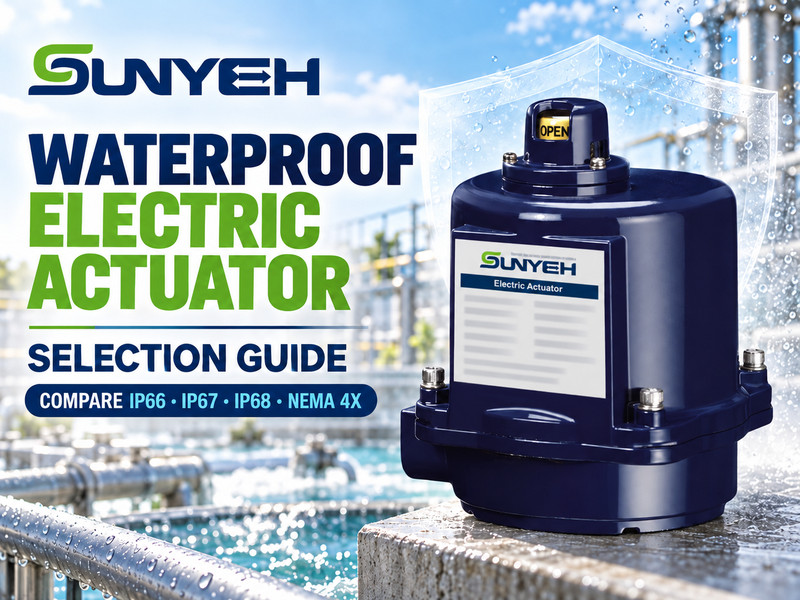
Choosing a Waterproof Electric Actuator: What IP66, IP67, IP68, and NEMA 4X Really Mean
2026-10-15
When selecting a waterproof electric actuator, the key question is not simply whether the actuator is described as waterproof. The real question is whether its enclosure rating matches the conditions at the installation site.
At Sun Yeh Electrical Ind. Co., Ltd. (SUN YEH), we manufacture electric actuators for valve automation in water treatment, HVAC, food processing, chemical engineering, and other industrial applications. Depending on the site, an actuator may be exposed to rain, dust, washdown, humidity, corrosion, temporary flooding, or immersion.
IP66, IP67, IP68, and NEMA 4X address different aspects of environmental protection. Understanding these differences helps users select an actuator that suits the application without assuming protection that the rating does not provide.
Quick Answer: IP66 is commonly selected for dust and powerful water-jet exposure. IP67 adds protection against temporary immersion under defined test conditions. IP68 applies to immersion conditions specified by the manufacturer. NEMA 4X covers outdoor and water exposure while adding corrosion-related protection. Final selection should also consider product configuration, cable entries, mounting, ambient conditions, and maintenance requirements.
1. What Does “Waterproof” Really Mean for an Electric Actuator?
“Waterproof electric actuator” is a commonly used search term, but waterproof is not a complete engineering specification. In an industrial project, water resistance should be evaluated through a defined enclosure rating and the conditions under which the product was tested.
An electric actuator contains a motor, gears, electrical components, position-control devices, seals, cable entries, and enclosure joints. Its environmental protection depends on how these parts work together as a complete enclosure system.
Before selecting a rating, we recommend identifying the actual exposure:
Will the actuator be installed under shelter or in direct rain?
Will it be cleaned with hose-directed water?
Is temporary flooding possible?
Is immersion expected, and if so, at what depth and for how long?
Will it encounter saltwater, chlorinated water, detergents, or chemicals?
Could temperature changes cause condensation?
Does the site also require corrosion resistance or hazardous-area certification?
Key Takeaways
Waterproof is a general description rather than an unlimited guarantee.
Outdoor use, washdown, flooding, and immersion are different conditions.
Water composition, condensation, and corrosion require separate evaluation.
In IP66, IP67, and IP68, the first digit “6” indicates the highest defined level of protection against dust ingress. The second digit identifies the applicable water-ingress test category.
Rating
General Meaning
Typical Consideration
Important Limitation
IP66
Dust-tight and protected against powerful water jets
Outdoor rain, dusty sites, and suitable washdown applications
Does not establish immersion protection
IP67
Dust-tight and protected against temporary immersion under defined conditions
Locations where temporary flooding or immersion may occur
Does not mean permanent or unlimited submersion
IP68
Dust-tight and protected under manufacturer-specified immersion conditions
Applications requiring a defined immersion depth and duration
Conditions differ by model, manufacturer, and configuration
Water jets and immersion are different exposure types. An IP67 electric actuator may be suitable where temporary flooding is possible, but its published rating does not automatically confirm suitability for repeated high-pressure washdown. Likewise, an IP68 rating must be reviewed together with the manufacturer’s stated depth, duration, configuration, and operating limitations.
Key Takeaways
IP66 addresses dust and powerful water jets but not immersion.
IP67 covers temporary immersion under defined test conditions.
IP68 conditions must be verified for the exact model and configuration.
3. NEMA 4X vs. IP Ratings: Why They Are Not Directly Equivalent
NEMA enclosure types and IEC IP ratings are based on different classification systems. Although their requirements may overlap in certain areas, NEMA 4X should not be treated as a direct equivalent of IP66, IP67, or IP68.
NEMA 4X is commonly specified for indoor or outdoor enclosures exposed to windblown dust, rain, splashing water, and hose-directed water. The “X” also indicates an additional level of protection against corrosion. The NEMA enclosure standard should be consulted when a project specifically requires a NEMA type.
An IP rating focuses on solid-object and liquid ingress. It does not, by itself, describe all the environmental considerations covered by a NEMA enclosure type. NEMA 4X is also not a submersion rating; where flooding or immersion is possible, the applicable IP67 or manufacturer-specified IP68 conditions should be checked separately.
Key Takeaways
NEMA and IP ratings are different classification systems.
NEMA 4X adds corrosion-related protection not communicated by an IP code alone.
NEMA 4X should not be used as evidence of submersion capability.
4. Which Rating Fits Rain, Washdown, Temporary Immersion, or Submersion?
The most reliable way to select an outdoor electric actuator is to begin with the actual site conditions rather than simply choosing the highest rating listed in a catalogue.
Installation Condition
Initial Enclosure Consideration
What Should Be Verified?
Sheltered outdoor installation
Published outdoor-use rating suitable for the expected exposure
Humidity, condensation, drainage, and temperature
Direct rain and windblown dust
IP66 or another specifically approved outdoor enclosure
Rain direction, mounting, and cable entries
Routine hose-directed washdown
Published water-jet rating and required NEMA type
Pressure, distance, temperature, chemicals, and frequency
Temporary flooding
IP67 or a defined temporary-immersion specification
Maximum depth, duration, and configuration
Defined immersion condition
Manufacturer-specified IP68 configuration
Depth, duration, installation, and operating state
Corrosive outdoor environment
NEMA 4X or specified corrosion-resistant construction
Materials, coating, fasteners, and chemical compatibility
Hazardous wet location
Required explosion protection plus a suitable ingress rating
Area classification, temperature class, and enclosure rating
A wastewater treatment facility may need protection against outdoor weather, humidity, corrosive gases, and temporary flooding. A food-processing application may place greater emphasis on washdown conditions and detergent compatibility. A below-grade valve chamber may require special attention to condensation and flooding.
Ingress protection and explosion protection must be evaluated separately. An IP68 actuator is not automatically explosion-proof, while an explosion-proof enclosure does not automatically provide the immersion performance required by a project.
The enclosure rating listed in a product specification applies to the tested product configuration. The protection achieved at the installation site can be affected by wiring, mounting, maintenance, and environmental conditions.
Cable entries are particularly important. Even when the actuator enclosure has an appropriate rating, moisture may enter if a cable gland is incorrectly sized, inadequately tightened, damaged, or unsuitable for the cable diameter. Unused conduit openings also require correctly rated sealing components.
Before commissioning the actuator, we recommend checking the following:
Use cable glands, conduit fittings, plugs, and seals suitable for the required environment.
Confirm that all unused cable entries are correctly sealed.
Tighten covers and fasteners according to the product instructions.
Inspect gaskets and O-rings for damage, contamination, or incorrect placement.
Route cables to reduce the possibility of water travelling toward the enclosure.
Follow the permitted mounting orientation.
Consider whether temperature changes could cause internal condensation.
Recheck seals after wiring, inspection, repair, or maintenance.
Do not pressure-wash the actuator unless its rating and instructions permit the intended method.
In humid environments or locations with significant temperature changes, condensation may develop without direct water entry. Available anti-condensation measures, such as a space heater or thermostat, should therefore be evaluated according to the selected model and environment.
Key Takeaways
The enclosure, seals, cable entries, fittings, and installation form one protection system.
Incorrect conduit sealing can reduce field protection.
Protection should be inspected again after the enclosure is opened or serviced.
6. SUN YEH Enclosure Ratings: Which Series and Specifications Should You Verify?
SUN YEH provides quarter-turn, linear, multi-turn, spring-return, and explosion-proof electric actuator solutions. Because enclosure protection is model- and configuration-specific, users should verify the current specification for the exact actuator being considered.
OM Series Quarter-Turn Electric Actuators
Published specifications for several OM Series models identify NEMA Type 4X, IP66, and IP67 protection and state that the products are intended for outdoor use. For example, the OM-1 Quarter-Turn Electric Actuator publishes these enclosure ratings.
Also explore the OM-G, OM-H, and OM-6. Always confirm the exact model, available options, torque, control, mounting, and duty requirements.
Available models also include the L-500, L-1000, and L-2000. Selection should consider thrust, stroke, speed, control, mounting, and environmental conditions.
Selected Products with Published IP68 Conditions
SUN YEH publishes model-specific IP68 conditions for selected OM, OME, LE, S/SE, and M Series actuators. The permitted depth, duration, enclosure construction, and configuration may differ between products.
For example, certain documentation may specify IP68 at 7 metres for 72 hours for selected models or configurations, while the specified M Series configuration publishes IP68 at 8 metres for 120 hours. These conditions apply only to the products and configurations identified in the corresponding documentation.
Specification reminder: Do not apply one product’s immersion depth or duration to an entire series. Review the latest specification for the exact model being considered and confirm whether the intended installation or operation falls within the published conditions.
Before identifying a suitable solution, we recommend confirming valve motion, torque or thrust, power supply, control signal, duty requirements, ambient conditions, water exposure, corrosion risk, certifications, mounting, and cable-entry arrangement.
For applications requiring product development or customized integration, SUN YEH also provides an ODM/OEM cooperation process. Available cooperation may include requirement confirmation, feasibility assessment, design planning, prototype development, customer review, manufacturing, quality control, and after-sales support. Final availability remains subject to technical evaluation and agreement.
Key Takeaways
SUN YEH enclosure ratings vary by model and configuration.
Several OM Series models publish NEMA 4X, IP66, and IP67 protection.
The L Series includes published IP67 and NEMA 4X options for linear valve applications.
IP68 depth and duration must be confirmed from the exact product documentation.
7. FAQ: Waterproof and Outdoor Electric Actuator Selection
Is an IP67 electric actuator completely waterproof?
An IP67 electric actuator is protected against temporary immersion under defined test conditions. The rating does not establish unlimited depth, permanent submersion, or resistance to every chemical or liquid. Compare the product’s published conditions with the actual installation environment.
Is IP68 always better than IP67?
Not necessarily. IP68 may be appropriate when a defined immersion risk exists, but it does not replace correct actuator sizing, cable sealing, corrosion evaluation, mounting, or maintenance. If the primary exposure is washdown, the required water-jet rating should also be reviewed.
Can an IP66 electric actuator be installed outdoors?
An IP66 actuator may be suitable for many outdoor environments when the manufacturer identifies the product as suitable for outdoor use and it is installed according to the applicable instructions. Weather exposure, drainage, cable entries, condensation, temperature, corrosion, and maintenance should still be considered.
Does NEMA 4X mean that an actuator can be submerged?
No. NEMA 4X addresses conditions including outdoor exposure, hose-directed water, and an additional level of corrosion protection. It is not a submersion rating. Where immersion is possible, verify the relevant IP67 or manufacturer-specified IP68 conditions.
Can an IP68 actuator operate while submerged?
Not automatically. IP68 establishes protection under the manufacturer’s stated conditions, but it does not necessarily confirm that the actuator may be energized or cycled underwater. Confirm the depth, duration, operating state, cable-entry arrangement, and water conditions.
Are explosion-proof and waterproof electric actuators the same?
No. Explosion protection addresses ignition hazards in classified locations, while an IP rating addresses dust and water ingress. A wet hazardous location may require both the appropriate explosion-protection certification and a suitable ingress rating.
What information should I provide when requesting an actuator recommendation?
Please provide the valve type, required motion, torque or thrust, power supply, control signals, operating frequency, ambient temperature, water exposure, required immersion depth and duration, chemical conditions, hazardous-area classification, mounting orientation, and cable-entry requirements.
Conclusion
Choosing a waterproof electric actuator begins with defining the actual operating environment. IP66 is commonly applied where protection against dust and powerful water jets is required. IP67 adds temporary-immersion protection under defined conditions, while IP68 must be evaluated according to the manufacturer’s model-specific depth, duration, and configuration. NEMA 4X covers outdoor and water exposure while adding corrosion-related protection, but it is not a substitute for an immersion rating.
At SUN YEH, we recommend evaluating enclosure protection together with valve motion, torque or thrust, control method, power supply, duty requirements, mounting, corrosion exposure, and applicable safety certifications. This approach helps identify an electric actuator that fits both the valve and its operating environment.
Need Help Reviewing Your Application?
Send us your valve information, operating requirements, control specifications, and environmental conditions. We can review the available product documentation and help determine which actuator configuration should be considered.